Here is a fantastic cartoon that highlights some of the problems with science. At the end of the day, science is a human activity, so it shouldn't be surprising that all the flaws humans succumb to also infect their scientific activities.
Showing posts with label science. Show all posts
Saturday, January 30, 2021
Tuesday, July 21, 2020
John Oliver on Conspiracy Theories
If you spend much time on this blog, you can see that I am a big fan of Last Week Tonight with John Oliver. In particular, Oliver tends to do lengthy segments that are a deep dive into a particular topic. As of this posting, his most recent long segment was about conspiracy theories. While the focus was, given the current context, coronavirus conspiracies, many of the general points he makes about why conspiracy theories are popular and how to combat them are quite relevant to any conspiracy theory one might encounter.
Tuesday, May 19, 2020
What's wrong with this picture
In the midst of the COVID-19 pandemic, the Georgia Department of Public Health released the following chart:

They key thing to note are the dates along the bottom.
h/t to Tom Sullivan at Digby's Hullabaloo

They key thing to note are the dates along the bottom.
h/t to Tom Sullivan at Digby's Hullabaloo
Monday, May 9, 2016
Science!
John Oliver gives a fantastic takedown of some of the terrible science reporting one finds in the media, and also gives a good analysis of some of the causes.
Wednesday, September 25, 2013
Climate Change, Arctic Ice, and Statistics
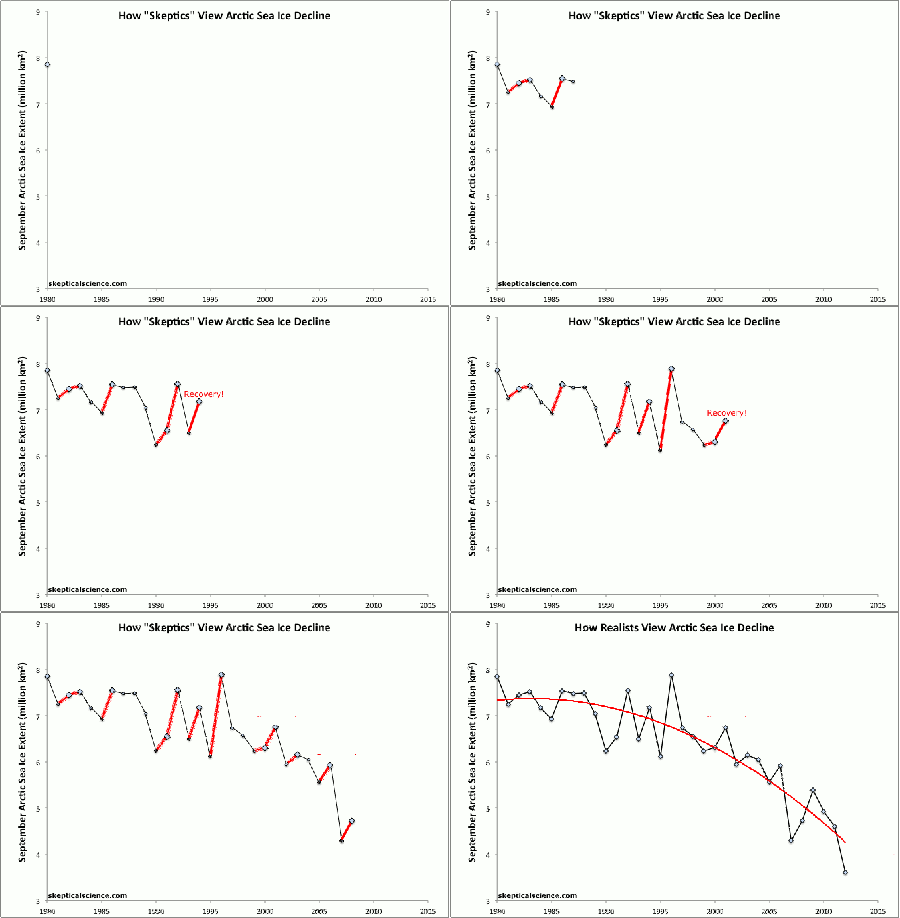
As some of you may know, 2012 was a record low for Arctic sea ice. This year, Arctic sea ice has increased by 60%, and some are using this fact to argue that global warming is not real. However, those making this case do not understand how statistics work. In particular, they fail to understand a statistical phenomenon known as Regression to the Mean. The basic idea here is that if one has a measurement that is particularly extreme, then the next measurement will be much closer to the average or mean. In the case of Arctic sea ice, since 2012 was a record low, we would expect that in the next year we would see an increase. As Dr. Steven Novella puts it in reference to the image above:
Dana Nuccitelli at The Guardian has a nice graphic showing Arctic sea ice trends from 1980 to this year. In this graph you can see the background fluctuation year to year, but also the clear downward trend overall. Another trend is also apparent – following any year with a record low Arctic ice measurement, the following year is likely to have increased total ice. This is simply regression to the mean. In any fluctuating system, extreme values are likely to be followed more average values. [sic]The upshot of this is that when we are looking at a complex phenomenon like climate change, we need to look at the whole picture to understand what is going on. If we simply pull out a small segment of the entire picture, say by just focusing on the years 2012 and 2013 (an example of Cherry Picking) it can seem like global warming is on the wane. However, if we pull back and take a broader look we can see that the trend for Arctic sea ice clearly shows that the amount is decreasing over time. And this provides further evidence that global warming is a real phenomenon.
Monday, August 19, 2013
Vaccines and Science
In reading my usual daily blog posts, I came across a link to this excellent article summarizing the reasons to get vaccinated and to vaccinate one's children. I particularly liked it because it runs through all the evidence (with links) and provides responses to some of the standard anti-vaccine arguments. In so doing the author, Dr. Jennifer A. Raff (with doctorates in Anthropology and Genetics!), does a very nice job of summarizing how science functions and why scientific experiments are really the only way to figure out how the world actually works. You should read the entire piece, but I want to focus on the following:
h/t to Pharyngula
Science operates based on the philosophy that the truth is knowable if we design experiments correctly, and we do enough of them to rigorously test our hypotheses. And I hope that you know by now that anyone with a keyboard can make stuff up. Peer review is how we test that someone isn’t making things up. Experts in your field have to agree with your conclusions.To me, this is the essential point about science and why science is so valuable and important. In this day and age anyone with access to a computer can write and say anything he or she wants. This blog that I write on costs me nothing and I have total freedom to post anything I want. I try to be accurate and I try to ensure that my claims are true, but basically you only have my word (and your own independent analysis) to go on. Science, by contrast, won't accept anything based on someone's say-so. Instead, science consists of a rigorous set of practices and a methodology to eliminate, as much as possible, human bias and human error. In addition, science has peer review whereby other people examine claims and evidence, and retest to ensure that the results are as accurate as they can be. It is often the case that scientists or doctors are accused of being elitists, or in the pocket of this or that special interest group, but even when these claims are true, the methodology of science and the peer review process can weed out these conflicts of interest and get us as close as possible to the Truth. There is simply no other method that we have that can achieve the same results. And this is why, as Dr. Raff writes, "Your physician knows more than the University of Google."
h/t to Pharyngula
Tuesday, June 18, 2013
What is it with Republicans and Making Up Facts?
What is it with Republicans and bad science? They seem to invent justifications for whatever political position they have already decided on, and then dress these rationalizations up in sciency sounding language. Unfortunately for these politicians, reality often does not conform to their worldview. As a case in point, we can take former OB/GYN Rep. Michael Burgess (R-TX):
So, according to Rep. Burgess, fetuses feel pain, and male fetuses masturbate as early as 15 weeks, and this is evidence that abortion should be banned much earlier than the 20 week ban under consideration. He further notes that, "There is no question in my mind that a baby at 20-weeks after conception can feel pain." Unfortunately despite his experience delivering babies, Rep. Burgess's views are well outside the mainstream scientific consensus and have no basis in reality. According to this systematic review published in the Journal of the American Medical Association, fetuses lack the ability to feel pain until the beginning of the third trimester, which is about 24 weeks, and significantly later than the 15 weeks suggested by Rep. Burgess.
So, what is going on here. I think we have a combination of Wishful Thinking and Pareidolia. Burgess has faith in the truth of his conclusions, so he goes out and looks for evidence that he thinks confirms his beliefs. When he sees sonograms of male fetuses with their hands between their legs, he interprets this as the fetus masturbating (why his mind goes there and why he doesn't think female fetuses masturbate is a question for the psychiatrists to answer). He sees the vague and random movements of an early term fetus and interprets those movements as purposeful because he wants that to be true because it supports his conclusions. The key here is that his beliefs about fetal pain perception are not formed on the basis of evidence, but rather he has decided that early term fetuses do feel pain, and then looks for evidence to support that belief. Someone who had a genuine interest in crafting effective legislation would develop positions on the basis of evidence rather than look for evidence that supports one's pre-existing biases.
h/t to Salon
So, according to Rep. Burgess, fetuses feel pain, and male fetuses masturbate as early as 15 weeks, and this is evidence that abortion should be banned much earlier than the 20 week ban under consideration. He further notes that, "There is no question in my mind that a baby at 20-weeks after conception can feel pain." Unfortunately despite his experience delivering babies, Rep. Burgess's views are well outside the mainstream scientific consensus and have no basis in reality. According to this systematic review published in the Journal of the American Medical Association, fetuses lack the ability to feel pain until the beginning of the third trimester, which is about 24 weeks, and significantly later than the 15 weeks suggested by Rep. Burgess.
So, what is going on here. I think we have a combination of Wishful Thinking and Pareidolia. Burgess has faith in the truth of his conclusions, so he goes out and looks for evidence that he thinks confirms his beliefs. When he sees sonograms of male fetuses with their hands between their legs, he interprets this as the fetus masturbating (why his mind goes there and why he doesn't think female fetuses masturbate is a question for the psychiatrists to answer). He sees the vague and random movements of an early term fetus and interprets those movements as purposeful because he wants that to be true because it supports his conclusions. The key here is that his beliefs about fetal pain perception are not formed on the basis of evidence, but rather he has decided that early term fetuses do feel pain, and then looks for evidence to support that belief. Someone who had a genuine interest in crafting effective legislation would develop positions on the basis of evidence rather than look for evidence that supports one's pre-existing biases.
h/t to Salon
Thursday, November 15, 2012
Electoral Denialism on the Left: The Case of Proposition 37
This will be a long one. Though I have written many posts in the past few days looking at Right-Wing denialism regarding the election, I want to pivot a bit and look at some denialism from the Left. In particular, I want to focus on a series of articles written by Jon Rappoport and posted at NaturalNews.com which claim that the election results for Proposition 37 (a proposition that would have mandated labeling of food with GMO ingredients) in California have been fixed. The articles in question can be found here and here, and I intend to unpack them in some detail because they are a treasure-trove of factual errors, fallacious reasoning and conspiracy mongering, and they reveal how a failure to think critically can lead someone to make some rather absurd and nonsensical claims.
Tuesday, November 13, 2012
Difficulties in the interpretation of data
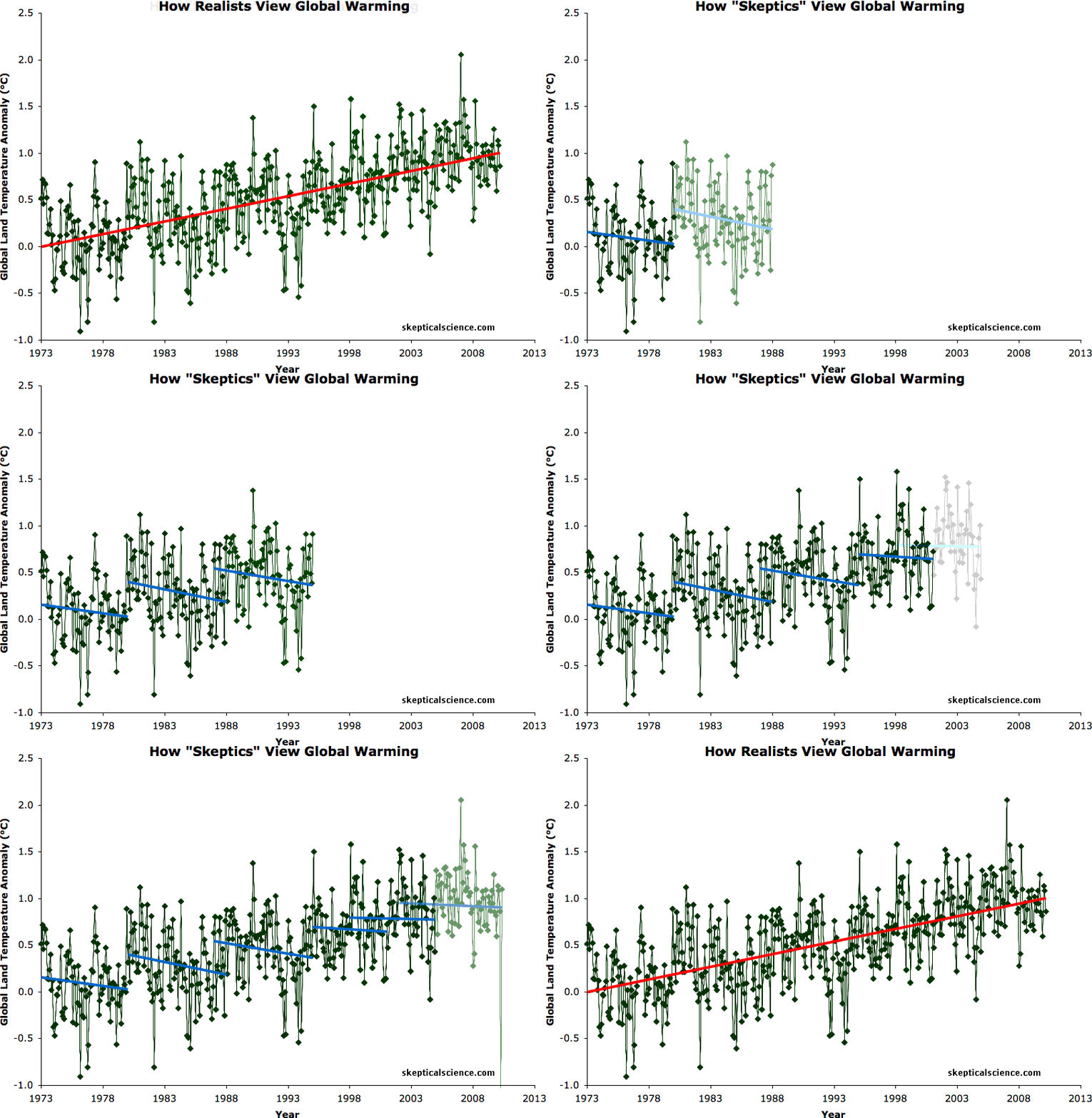
This gif nicely shows how two people can look at the same data and come to radically different conclusions.
It comes from this website, and it raises a really interesting point about how science is conducted and how there can sometimes be a real art in moving from data to conclusions about that data.
h/t to Pharyngula
It comes from this website, and it raises a really interesting point about how science is conducted and how there can sometimes be a real art in moving from data to conclusions about that data.
h/t to Pharyngula
Monday, September 24, 2012
Big Pharma Hides the Truth
The science columnist, author, and academic Dr. Ben Goldacre, has just written a new book about the pharmaceutical industry, Bad Pharma: How Drug Companies Mislead Doctors and Harm Patients. In connection with the publication of this book, The Guardian has published an excerpt. In this excerpt, Goldacre discusses a number of fallacies regularly committed by the pharmaceutical companies in their efforts to get their drugs approved for use by various government regulatory agencies. We can see these fallacies clearly exemplified in Dr. Goldacre's discussion of the anti-depressant reboxetine.
Subscribe to:
Posts (Atom)